


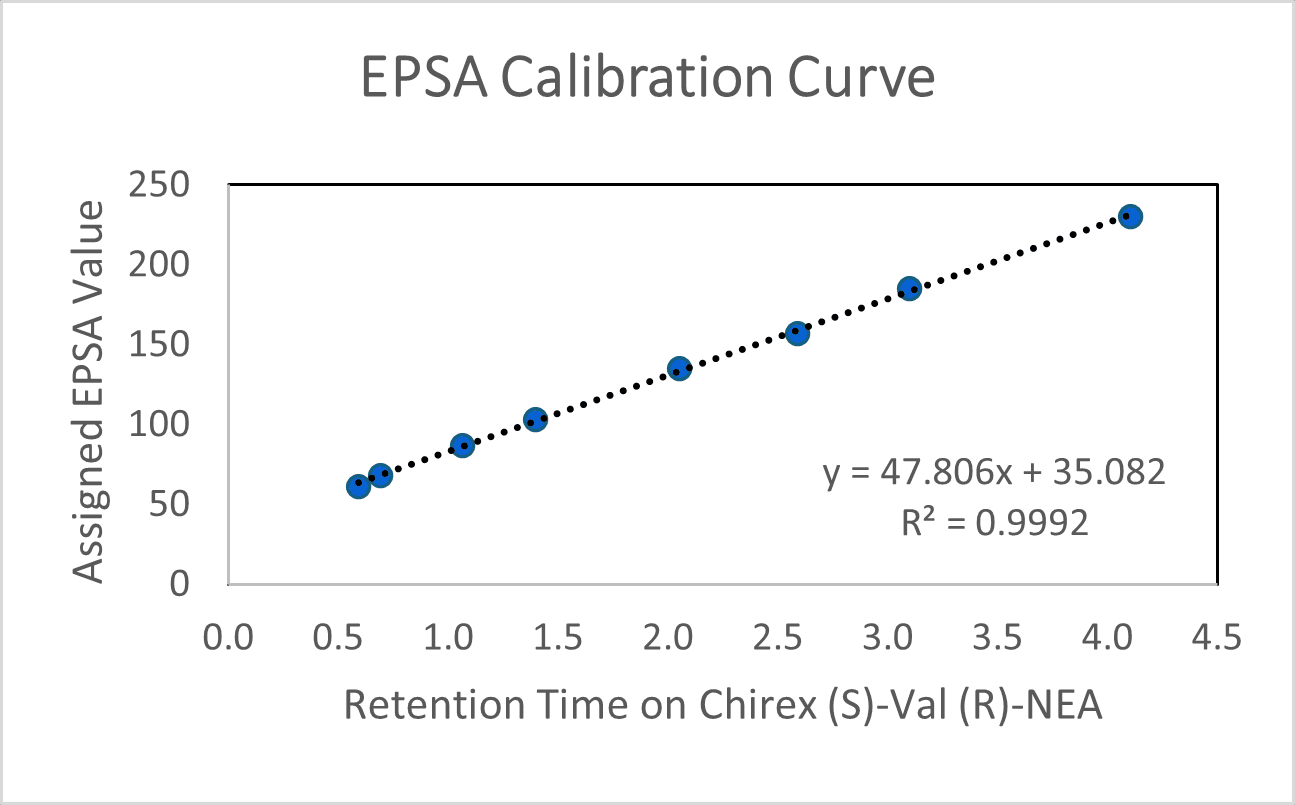
Utilizing SFC, EPSA can be considered as a descriptor of permeability (1), intramolecular hydrogen bond (2), and predictor of fraction absorbed (3), (with EPSA/TPSA ratio) for macrocycles and other potential large molecules.
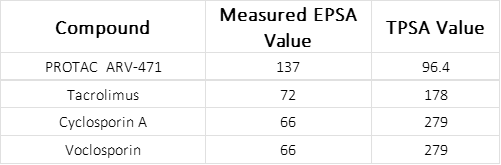
An experimentally determined EPSA value that is lower than expected—based on calculated polarity or topological polar surface area (TPSA)—suggests the presence of hidden polarity arising from a specific molecular conformation. This effect is often associated with intramolecular hydrogen bond (IMHB) formation, typically with a propensity of at least 60%.
When below 80, EPSA can be considered a useful descriptor of permeability, particularly for cyclic peptides with molecular weights between 500 and 2000 that contain polar functionalities and hydrogen bond donors (HBDs), that are often forming the intramolecular hydrogen bonds (IMHB),
In addition to determining EPSA in a high-throughput format, Analiza can provide strategic guidance throughout your project by combining and interpreting additional physicochemical properties.
References:
(1): https://doi.org/10.1021/ml500239m